XM Review

4.8/5
Trusted & Regulated
Patrick LewisPatrick Lewis

Written by

Patrick Lewis
Grace SullivanGrace Sullivan

Fact Checked by

Grace Sullivan

Updated

Recently
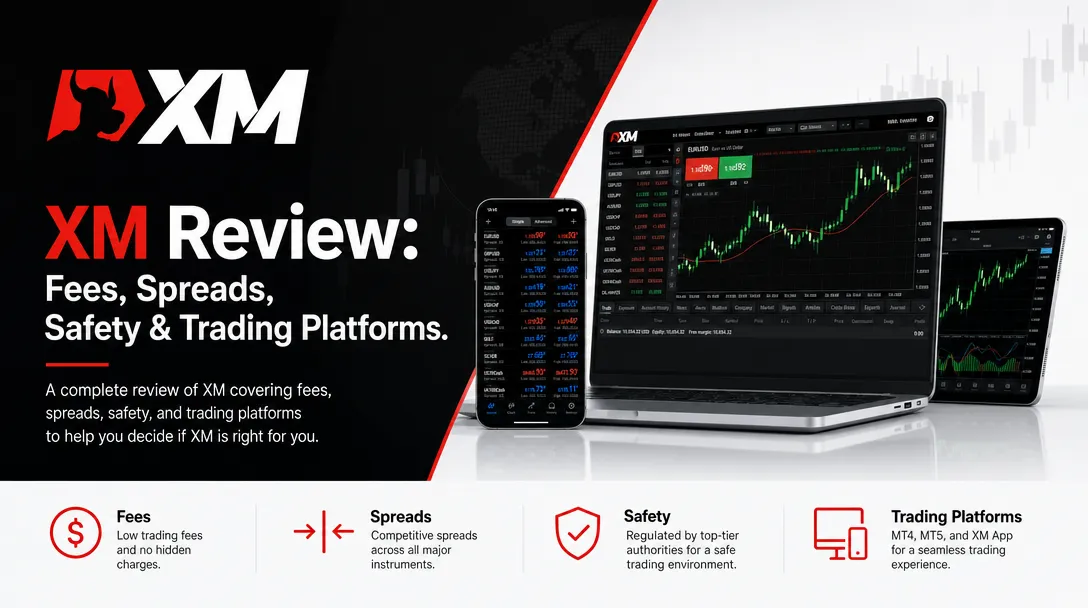
XM Review – fees, spreads, safety and trading platforms

When it comes to picking a forex or CFD broker, you've got a lot of options - hundreds, in fact. Many of them seem to offer pretty similar things, so it's not just about finding the one with the lowest fees or the highest leverage.

It’s important to think about what really matters, like whether they're properly regulated, how much it's going to cost you to trade, how good their platform is, and what the overall experience is like. These are the things that can make a big difference in the end.

XM has been around since 2009 and has become a well-known name in online trading. They work with clients from many countries, giving them access to over 1,400 CFDs in areas like forex, stocks, commodities, and more. XM also uses popular platforms like MetaTrader 4 and MetaTrader 5, and clients can start trading with a deposit as low as $5 for most accounts.

Is XM Safe & Regulated?

When it comes to picking a broker, trust is a big deal. Clients want to know that their money is safe and that the broker is playing by the rules. A broker that's well-regulated is usually a good sign, it means they have to follow strict financial rules and be transparent about what they're doing. This helps keep clients money protected, which is a top priority.

XM is governed by multiple governments and has been in operation for over 15 years. Despite not being publicly traded and not functioning as a bank, the company has established a solid reputation over the years and is overseen by several financial regulators.

A. Regulatory Oversight

XM uses a number of regulated companies to deliver its services. The organization that oversees an account is determined by the client's residence, hence the degree of investment protection may differ between nations.

Some of XM’s primary regulatory licences include:

  • Cyprus Securities and Exchange Commission (CySEC) – Licence No. 120/10

  • Dubai Financial Services Authority (DFSA)

  • Financial Services Commission (FSC) Mauritius

  • Financial Sector Conduct Authority (FSCA) South Africa

  • Financial Services Authority (FSA) Seychelles

According to some sources, Trading Point Group which is XM’s parent company also operates under a number of Tier-1 regulators through its affiliated brands, including the Financial Conduct Authority (FCA) in the UK and the Australian Securities and Investments Commission (ASIC). These entities are known for enforcing strict policies on financial reporting, client fund protection, and business practices.

B. How Client Funds Are Protected

XM states that they kept client funds in separate accounts. In short, customer money are kept apart from the company's operating funds. This lessens the possibility that customer money will be utilized to pay for the broker's regular operating costs.

If the broker goes bankrupt, some traders might also get further protection, depending on the regulatory body. For instance, up to €20,000 in compensation through the Investor Compensation Fund (ICF) may be available to qualified retail clients who trade under the CySEC-regulated entity.

Additionally, XM offers negative balance protection, which prevents retail traders from losing more money than they have put into their trading accounts. During times of severe market volatility, losses are restricted to the available account balance rather than generating new debt.

C. Security Measures

XM employs a number of security procedures in addition to regulations to help protect client accounts and personal data.

Sensitive information is protected during online transactions by the broker's use of SSL encryption to secure its website and trading platforms. In order to lower the possibility of unwanted access, XM additionally uses identity verification processes while opening accounts and handling withdrawals.

The broker also employs internal risk management technologies to keep an eye on account activity and adhere to local financial requirements.

So, is XM safe? XM is a pretty credible company, mainly because it's been around for a long time and is regulated by a lot of different authorities. But, the level of protection clients get still depends on which part of XM they’re working with.

XM logo

XM

Fee LevelLow
Inactivity Fee$15 after 90 days, then $10/month
Index CFD FeeLow
Investor ProtectionNegative Balance Protection
Mobile PlatformYes / MT4, MT5, XM App
Visit XM

Fees & Spreads

XM spreads and trading fees across popular markets

Trading costs can really add up and affect how much money clients can make. Even small differences in what clients pay to but or sell something can make a huge difference over time.

XM has different types of accounts, and each one has its own way of charging fees. Some accounts include the costs of trading in the price, while others have lower prices but charge a separate fee. This means that traders can pick the account that works best for them, depending on how they like to trade.

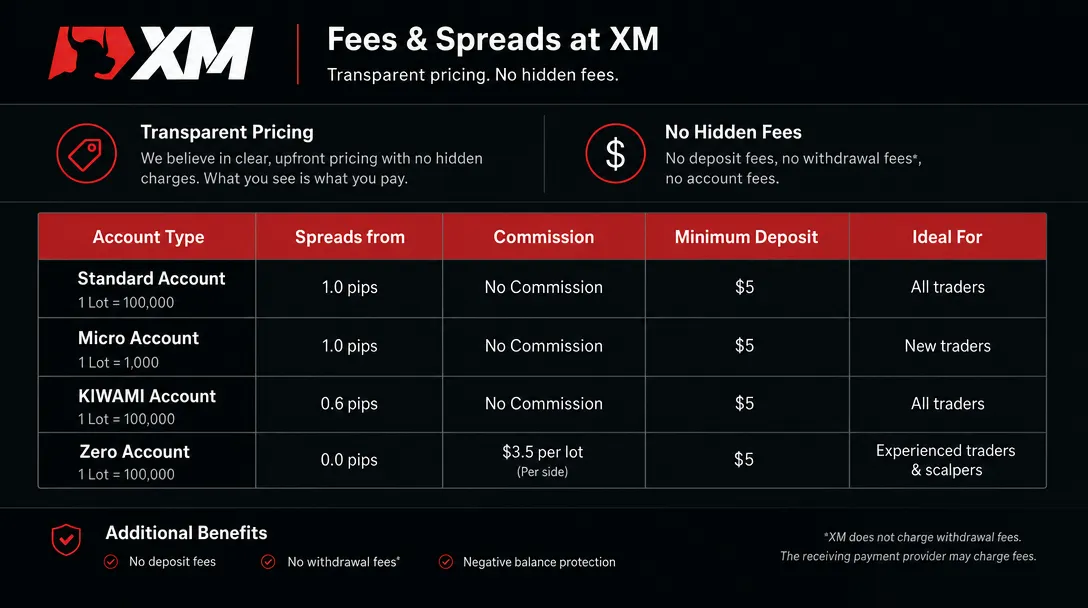
A. Standard, Micro, and XM Zero Accounts

The Standard Account is the simplest option. It doesn't come with a separate commission fee, because the trading costs are already factored into the spread. XM says that spreads typically start at 1.6 pips, but they can fluctuate depending on what's happening in the market.

The Micro Account is similar to the Standard Account, but it lets traders buy and sell smaller amounts. This is helpful for people just starting out, because they can try trading without risking too much money at once. Also, like the Standard Account, there are no extra fees for trading.

The XM Zero Account is a bit different when it comes to pricing. It can offer spreads as low as 0.0 pips, which is really attractive. However, to make up for it, the account charges a fixed commission on every trade that's made. This type of account is usually preferred by traders who are very active and make a lot of trades, because they want to be able to get in and out of the market quickly and with the lowest possible spreads.

B. Other Trading and Account Fees

XM charges swap fees for positions held overnight. The amount depends on the trading instrument and current interest rates. It also charges an inactivity fee for dormant accounts that still have available funds.

XM provides swap-free (Islamic) accounts on specific account types for traders who adhere to Islamic financial principles. These accounts offer trading circumstances that are normally comparable to those of standard accounts, although they neither charge nor pay overnight interest.

In certain areas, XM offers leverage of up to 1:1000; however, the maximum amount is contingent upon the account type and regulatory body. Larger positions with less cash are made possible by higher leverage, but it also raises the danger of losses, particularly for novice traders.

Trading Platforms & Tools

XP has a simple platform and only focuses on two of the most widely used trading platforms, MetaTrader 4 (MT4) and MetaTrader 5 (MT5). More recently, the broker has also added TradingView, giving traders another option for market analysis and charting.

All these platforms are accessible on web or even mobile. This means clients can get to their accounts from almost anywhere, without having to switch brokers or account types.

A. MetaTrader 4 (MT4)

For a long time, MT4 has been a top choice for forex traders, and XM still backs it for those who like its classic design.

This trading platform has all the tools needed for everyday trading. It provides real-time prices, technical indicators to support trading decisions, and one-click trading. It also allows custom watchlists. Plus, it works with Expert Advisors, which are like robots that can automatically buy and sell based on rules set in advance.

MT4 is still widely used today, even though it's been around for a while. This is because it's really stable and easy to get the hang of. Plus, there are tons of people online who use it and share free tools and indicators, which is a big help.

B. MetaTrader 5 (MT5)

By providing more trading tools and support for more markets, MT5 expands on the characteristics of MT4.

It has more chart timeframes, additional order kinds, an integrated economic calendar, and a wider range of technical indicators than MT4. Additionally, it enables traders to use a single platform to access a variety of trading products.

MT5 is typically a preferable option for traders who want more recent capabilities without sacrificing the classic MetaTrader experience.

C. TradingView

Additionally, XM now supports TradingView, a platform that has grown in popularity among traders because to its sophisticated charting tools and elegant design.

TradingView facilitates the analysis of market movements by providing interactive charts, hundreds of technical indicators, and sketching tools. Additionally, there is a sizable online community where traders may watch market trends, exchange ideas, and discuss strategy.

The ability to link TradingView with an XM account makes trading more convenient for traders who already use it for chart research.

D. Mobile Trading

MT4 and MT5 are also available on both Android and iOS devices. They include most of the same features as the desktop versions, such as chart analysis, order placement, account management, and price alerts.

While smaller screens can make chart analysis less comfortable than on a desktop, the apps still perform well for monitoring positions or placing trades while on the move.

C. Research and Educational Tools

One area where XM stands out is its educational content and market research.

The broker shares its market expertise with clients every day through a variety of media, including articles, videos, webinars, and podcasts, all available in several languages. Additionally, it gives clients access to Trading Central, a powerful research tool that generates trading ideas, provides in-depth technical analysis, and offers valuable market insights to help them make informed decisions.

Additionally, XM prioritizes educating traders far more than many other forex brokers. While more seasoned traders can follow daily market updates and professional analysis, beginners can access instructional videos and platform guidelines.

For traders of all skill levels, XM offers a full trading experience. The broker makes up for its lack of a proprietary platform by providing a variety of well-known trading platforms, such as MT4, MT5, and TradingView. Additionally, traders can use XM's vast collection of research and educational materials to improve their methods and make well-informed decisions.

Account Types

XM has different types of accounts that work for various trading styles and levels of experience. The big differences between these accounts are the minimum amount of money needed to get started, how they charge fees, and the size of the trades that can be made—not really the markets available for trading.

There are accounts for beginners and experienced traders. Each one is set up to meet different needs, so traders can choose the one that works best for them.

A. Standard Account

The Standard Account is the most common option and is suitable for a wide range of traders.

It doesn't take a lot to start trading with this account, just $5 is enough. And the good thing is, there are no extra charges for each trade. The cost of trading is already included in the price difference, so there's no need to add up a bunch of different fees before making a trade. This way, everything is simple and easy to understand.

B. Micro Account

The Micro Account is designed for traders who want to start with smaller trade sizes.

When it comes to trading, people don't always buy and sell big amounts. Sometimes they use something called micro lots, which are much smaller. This is really helpful for new traders who are still learning the ropes, or for those who like to play it safe. The minimum amount needed to open the account is $5, and there are no extra trading fees.

C. XM Zero Account

The XM Zero Account is intended for traders who want lower spreads.

This type of account is different from the Standard and Micro accounts because it charges a fee for each trade, but it offers very small spreads, sometimes as low as 0.0 pips. Traders who buy and sell often usually like this pricing model because it can help them save money in the long run. They can make lots of trades without having to pay a lot for each one.

The XM Zero Account has a pretty high minimum deposit of $100, which makes it harder for some people to open one compared to the other account types.

D. Demo and Islamic Accounts

XM also offers a demo account, which is like a practice account where traders can try things out with virtual money before trading with real funds. This demo account is really helpful because it feels just like a real account, so traders can get used to how everything works or test out new trading ideas without risking any actual money.

For traders who follow Muslim beliefs, there's a special kind of account available. This account doesn't charge any extra fees for keeping a trade open overnight, which is important for people who want to trade in a way that's okay with Islamic rules.

Can you open an account?

Global account availability

Yes, you can open an account at XM if you live in Indonesia!

Indonesia
Visit Brokers

Tradable Assets

XM gives traders access to over 1,400 CFDs in different financial markets. It may not have every type of investment out there, but it has a wide enough selection for most people who trade forex and CFDs. This means traders can find what they need, even if it's not everything.

When trading, all the products are dealt with as CFDs, or Contracts for Difference. This means traders can make money from how prices move, without actually having to own the thing being traded—it could be a currency pair, a stock, or even something like oil. Traders are basically just betting on whether the price will go up or down.

A. Forex

Forex remains one of XM's strongest product categories.

This broker gives traders a lot of options when it comes to currency pairs—over 55 of them. Major pairs like EUR/USD, GBP/USD, USD/JPY, and AUD/USD are available, along with less common currencies for those who want to try something different. Whether traders prefer to stick with familiar markets or explore less common ones, the broker offers major, minor, and exotic currency pairs.

B. Stocks, Indices, and Commodities

XM also provides a way to trade CFDs on stocks from big companies in the US, the UK, and Germany.

For traders interested in broader markets, the broker provides access to major stock indices, including the S&P 500, Nasdaq 100, FTSE 100, DAX, and several others.

Commodity trading includes popular products such as gold, silver, crude oil, natural gas, and agricultural commodities. These markets give traders opportunities to diversify beyond currencies.

C. Is XM’s Product Range Enough?

XM gives traders who focus on forex and CFDs a lot of markets to choose from. They have a mix of currencies, stocks, indices, commodities, and precious metals, which is enough for most trading plans.

This variety helps traders find what they need, whether they're looking at currencies, stocks, or other markets. With so many options, traders can try out different strategies and see what works best for them.

XM isn't the best choice for investors who want to hold onto their investments for a long time. This is because it doesn't let you directly own stocks or ETFs. Instead, it's more geared towards traders who want to make money from short-term changes in the market, rather than building a traditional portfolio of investments. XM is designed for people who want to buy and sell quickly, taking advantage of small price movements, rather than holding onto their investments for years.

Deposits & Withdrawals

When it comes to managing a trading account, XM tries to make things as simple as possible. The broker lets traders add or take out money using a variety of payment methods, and the minimum amount needed to deposit is pretty low. Plus, it doesn't charge extra fees for most transactions, which is a nice bonus. But, it's worth noting that the payment options available might be different depending on where traders live.

It's also important to mention that XM typically handles withdrawal requests pretty quickly, usually within a single business day. However, the actual time it takes for the funds to show up in an account can vary, and that really depends on the payment provider or bank being used.

A. Deposit Methods

XM supports a range of funding methods, including:

  • Bank transfer

  • Visa and Mastercard

  • Skrill

  • Neteller

  • Local bank transfer (in selected countries)

  • Other regional payment methods where available

When just starting out, it's great to know that not much money is needed to get going. With XM, the minimum deposit is really low—just $5 for the Micro and Standard accounts. But for the XM Zero Account, the minimum deposit is $100. This makes XM a pretty good choice for beginners who don't have a lot of capital to start with, making it easy to begin trading with a small amount of money.

B. Withdrawals

When withdrawing money from XM, the process is pretty simple. Usually, the funds are sent back using the same payment method that was used for the deposit. This is something that a lot of regulated brokers do to help keep client accounts safe.

When a withdrawal request is submitted, the broker usually processes it within a day or two of working hours. But how long it actually takes for the money to arrive can vary depending on the payment method. Credit cards, e-wallets, and bank transfers can each take a different amount of time. International bank transfers can sometimes take several working days before the money arrives.

C. Fees

XM doesn’t charge any fees for withdrawal and deposit. However, the bank the traders are using for the payment might still charge some fees, especially for international transfer or changing currencies.

Also, traders need to know about a cost called the inactivity fee. If their accounts aren’t used for a long time, XM might charge a monthly fee, as long as there’s still money in the account. Please keep in mind that this is not like some other brokers that don’t charge traders for not using their account. XM will keep charging traders every month for not using their accounts until the accounts are empty.

Customer Support

XM customer support available through live chat, email and phone

XM provides its customers with multiple channels of support, including live chat, email, phone, and a comprehensive online Help Center. This means that traders can choose the method that suits them best to get help with their accounts, payments, or trading platforms.

One of the benefits of XM's support system is that it's available in over 30 languages, making it easy for clients from all over the world to get the assistance they need. If you have a simple question, live chat is usually the quickest way to get an answer.

A. Education and Support Resources

In addition to customer support, XM stands out for its educational content. The broker often posts updates about what's happening in the market, writes articles about trading, and even makes podcasts and videos to help people learn.

They also have webinars and live sessions where people can watch and learn from others who are trading in real-time. Plus, they give access to Trading Central, which is like a toolbox for traders that gives them ideas, analysis, and technical tips to help them make good decisions.

Pros & Cons

Pros

  • Controlled by a number of reputable financial authorities
  • Low minimum deposit starting from $5
  • Supports popular platforms including MT4, MT5, and TradingView
  • Offers more than 1,400 CFDs in various marketplaces
  • Provide strong educational resources, including webinars, market research, and Trading Central
  • Customer support is available in over 30 languages

Cons

  • Standard accounts spreaders are much wider than those of other low-cost brokers
  • Charges an inactivity fee on dormant accounts
  • Does not provide a platform for proprietary trading
  • Account features and investor protections vary depending on the regulatory body
  • Not every region offers XM Zero Account
  • Certain jurisdictions do not offer cryptocurrency CFDs

Frequently Asked Questions (FAQ)

Is XM a regulated broker?

Yes, XM is overseen by a number of different financial authorities, like CySEC, DFSA, FSCA, FSC Mauritius, and FSA Seychelles. The one that's in charge depends on where the account is made.

What is the minimum deposit at XM?

The Standard and Micro accounts have a $5 minimum deposit, whereas the XM Zero Account has a $100 minimum.

Does XM support MetaTrader 5?

Yes. XM supports well-know platforms including MetaTrader 4 (MT4) and MetaTrader 5 (MT5) on desktop, web, and mobile devices. It also supports TradingView.

Does XM charge inactivity fees?

Yes, if an account is dormant for an extended period of time and there are still funds available, XM may charge a monthly inactivity fee.

Is XM available in the United States?

No, clients who reside in the United States are not legible to open an account in XM.

Final Verdict: Is XM Worth It?

XM is one of forex and CFD brokers that offers a strong regulation, accessible account options, and a wide range of educational resources. It is also known as one of the simpler brokers for beginners to start with, with a minimum deposit as low as $5.

Interestingly, it’s the overall trading experience that becomes the broker’s biggest strength, and not its pricing. Not only does it good for trading, but it’s also great for learning thanks to its advanced features, such as multilingual customer support, webinars, market research, and educational content.

However, XM isn’t the lower-cost broker on the market. Their standard account spreads tend to be higher than what other brokers offer, especially the ones that focus on keeping costs low. And, for those who don't trade often, consider it again because XM charges an inactivity fee. This could be a problem for traders who don't buy and sell frequently.

Overall, XM is a good option for traders who want a broker that is regulated, has low costs to get started, and offers reliable platforms and helpful educational tools. While some traders solely focus on the smallest differences in prices might find better deals elsewhere, XM provides a well-rounded service that works for both new and experienced traders of forex and CFDs.

Patrick Lewis
Written byPatrick LewisCFA | Trading ExpertPatrick Lewis is a CFA Charterholder with over a decade of experience in financial markets. He specializes in reviewing brokers and exchanges with a strong focus on transparency, fees, and regulatory standards.Read profile →